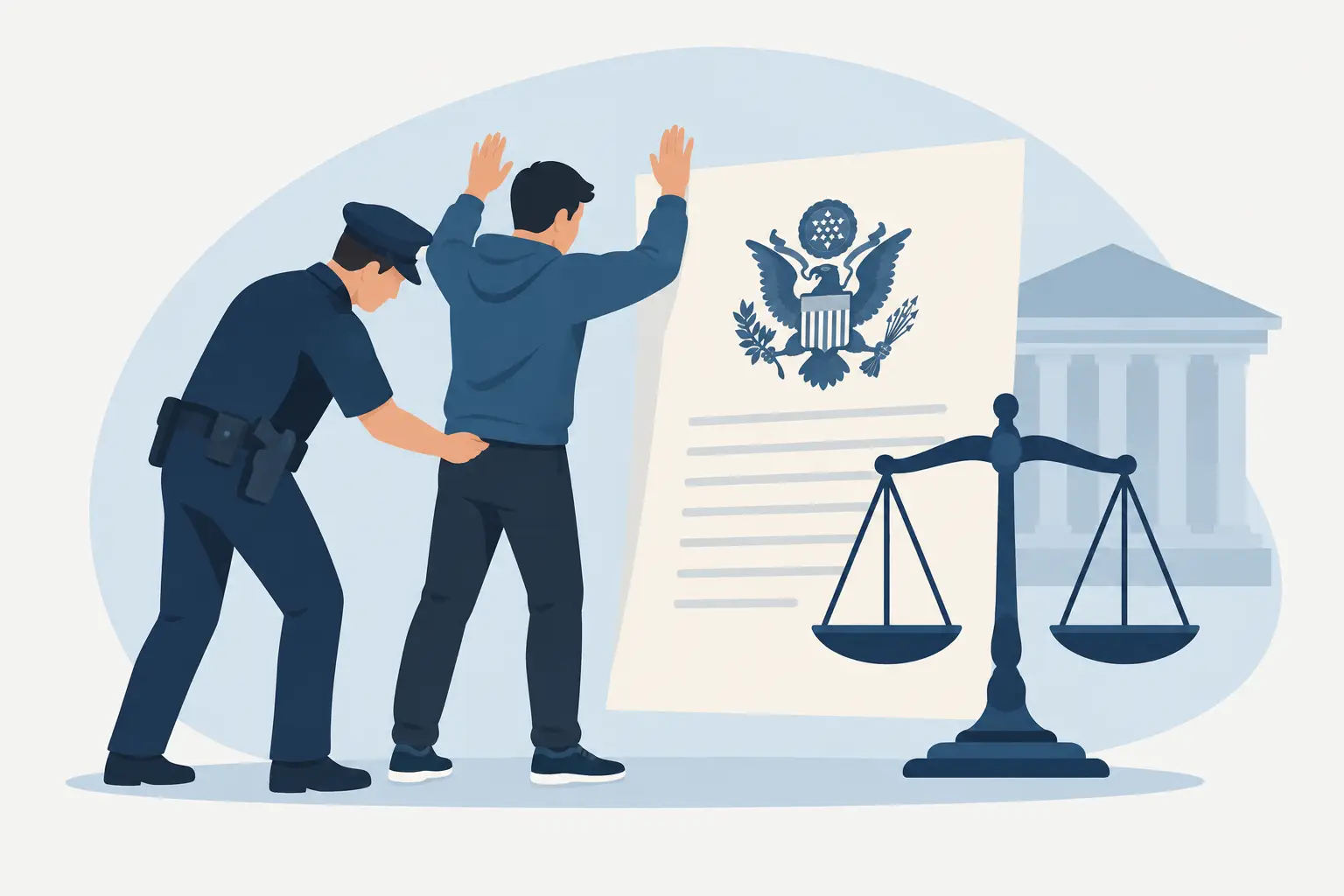
A police search can feel sudden and overwhelming: officers at your door, a request to look through your car, or a demand to access your phone after an arrest. But when is a search illegal? The answer usually turns on what officers searched, why they searched it, and whether they had a warrant or a recognized legal exception.
The Fourth Amendment protects people against unreasonable searches and seizures. Florida’s Constitution provides similar protection, and Florida courts generally follow United States Supreme Court decisions when deciding whether evidence was obtained unlawfully. A search that violates these protections may lead to a motion to suppress evidence. That can significantly affect a Florida state case or a federal prosecution in the Southern District of Florida, but it is not automatic. The facts and the timing of the defense matter.
When Is a Search Illegal Under the Fourth Amendment?
A search is generally illegal when law enforcement intrudes on a place or item where a person has a legitimate expectation of privacy without a valid warrant, probable cause, consent, or another recognized exception to the warrant requirement.
The home receives the strongest constitutional protection. Officers ordinarily need a warrant supported by probable cause before entering a home to search for evidence. A valid warrant must identify the place to be searched and the evidence or property officers are authorized to seize with reasonable particularity. A warrant that is too broad, based on misleading information, or executed outside its authorized scope can be challenged.
Privacy rights extend beyond a house. Depending on the circumstances, they may apply to an apartment, hotel room, private office, locked container, vehicle, cellphone, computer, and certain personal data. A person generally cannot challenge a search of property in which they had no privacy interest. For example, a passenger may be able to challenge an unlawful traffic stop but may not have standing to contest a search of the driver’s vehicle or belongings.
The central question is reasonableness, not whether officers used the word “search.” Looking into a phone, opening a closed bag, entering a residence, or collecting digital data can all qualify as searches. The law also recognizes that police may observe what is openly visible from a lawful vantage point without conducting a search.
A Warrant Is Not Always Required
Police do not need a warrant in every situation. This is where many search cases become fact-intensive. The government has the burden of showing that a warrantless search fits a valid exception.
Consent searches
An officer may ask for permission to search. If a person voluntarily consents, police may search within the scope of that consent. Saying, “You can look in the trunk,” does not necessarily authorize a search of a locked phone found there.
Consent must be voluntary, not the product of coercion or an unlawful assertion of authority. Whether someone was in custody, how many officers were present, what the officers said, and whether the person could realistically refuse are all relevant. A person with actual or apparent authority over a location may sometimes consent to a search, which can create difficult issues in shared homes, vehicles, and business settings.
You generally have the right to decline a request for consent. Do not physically interfere with officers or make false statements. State clearly that you do not consent, and ask to speak with an attorney as soon as possible.
Searches incident to arrest
After a lawful arrest, police may search the arrested person and the area immediately within that person’s reach. The purpose is officer safety and preventing the destruction of evidence. This exception does not give officers unlimited authority to search every room of a home or every digital device nearby.
Cellphones are especially important. In most cases, police need a warrant to search the contents of a cellphone, even after an arrest. They may secure the phone to prevent remote deletion, but scrolling through messages, photos, applications, or location information ordinarily requires judicial authorization.
Vehicle searches
A vehicle has less privacy protection than a home, but it is not search-free territory. Police may stop a vehicle only when they have reasonable suspicion of a traffic violation or criminal activity. A minor traffic infraction can support a stop, but it does not automatically permit officers to search the entire car.
If officers have probable cause to believe a vehicle contains evidence of a crime or contraband, they may generally search areas where that evidence could reasonably be found. Police may also conduct a limited protective sweep of areas accessible to an occupant when they reasonably believe the person is dangerous and may gain control of a weapon. Those are separate legal rules with separate limits.
Exigent circumstances and plain view
Police may enter without a warrant when an immediate emergency makes waiting impractical, such as responding to an active threat to life, pursuing a fleeing suspect, or preventing imminent destruction of evidence. Mere convenience or a generalized suspicion is not enough.
The plain-view doctrine can permit seizure of evidence that officers immediately recognize as connected to criminal activity while they are lawfully present. It does not allow an officer to move items, open drawers, or manipulate property just to create a better view.
Stops, Frisks, and Detentions Have Limits
A brief police detention, often called a Terry stop, requires reasonable suspicion based on specific facts that criminal activity is occurring, has occurred, or is about to occur. A vague hunch is not enough.
During a lawful stop, an officer may conduct a limited pat-down of outer clothing if there is reasonable suspicion that the person is armed and dangerous. A frisk is meant to locate weapons, not to search for drugs, identification, or other evidence. If an officer reaches into a pocket without a legal basis, any evidence recovered may be subject to suppression.
The length and scope of a traffic stop also matter. Officers cannot prolong a stop for unrelated investigative activity without additional reasonable suspicion. What may begin as a valid stop can become an unlawful detention if its purpose has ended and police continue holding the driver or passengers without legal justification.
Digital Searches Require Special Attention
Modern criminal investigations often turn on phones, cloud accounts, social media records, computers, and location data. These searches can reveal far more than a wallet, car, or filing cabinet. Courts therefore closely examine the scope of digital warrants.
A warrant to search a phone should identify the alleged offense, the categories of data sought, and the relevant time period when possible. A warrant that authorizes a broad, unrestricted review of every aspect of a person’s digital life may raise constitutional concerns. The same is true when investigators obtain location information or online account records without the process the law requires.
Do not consent to a phone search simply because an officer says cooperation will help. Do not attempt to erase data, reset devices, or direct someone else to do so. Those actions can create additional legal exposure. Preserve the device, say that you want an attorney, and obtain advice tailored to your situation.
Illegal Searches by Private Parties and Government Agents
The Fourth Amendment generally restricts government conduct, not searches by private individuals. If a private person searches property on their own and later gives evidence to police, the constitutional analysis may be different.
However, a private search can become a government search if law enforcement directed, encouraged, or substantially participated in it. This issue can arise with employers, informants, hotel staff, package carriers, and family members. The details of who initiated the search and what police knew beforehand can be critical.
What Happens If Police Conducted an Illegal Search?
The primary remedy is often a motion to suppress. Defense counsel may ask the court to exclude physical evidence, statements, digital data, or other evidence obtained through an unconstitutional search. Evidence derived from the original illegality may also be challenged as the “fruit” of that violation.
Suppression is not guaranteed simply because a warrant was absent or an officer made an error. Prosecutors may argue consent, probable cause, exigent circumstances, an independent source, inevitable discovery, or good-faith reliance on a warrant. A strong defense requires reviewing body-camera footage, dispatch records, reports, warrant affidavits, surveillance, and the precise sequence of events.
If officers searched your home, vehicle, business, phone, or belongings in Miami-Dade County, write down what happened while your memory is fresh. Record the time, location, officers’ statements, whether you gave consent, who was present, and what was taken. Do not discuss the facts with investigators without counsel. Early review by a qualified Miami criminal defense attorney can identify constitutional issues before critical hearings and charging decisions move forward.
Last updated: November 16, 2026
Important Disclaimer
This article is for general informational purposes and does not constitute legal advice. Reading this article does not create an attorney–client relationship. If you need legal assistance, please contact us for a Free Consultation.