The hardest decisions in a criminal case often come before a jury is ever sworn. If you are weighing trial versus plea agreement, you are not choosing between a simple good option and bad option. You are making a high-stakes decision that can affect your freedom, record, career, immigration status, finances, and family for years.
That is why this choice should never be made based on fear, pressure, or what happened in someone else’s case. It has to be made based on the evidence, the law, the prosecutor involved, the judge, the exposure at sentencing, and whether the defense is actually prepared to try the case.
Trial versus plea agreement is not a generic decision
People often ask whether it is better to take a plea or go to trial. The honest answer is that it depends on the case in front of you, not the label attached to the charge. A misdemeanor DUI, a federal fraud indictment, a drug trafficking case, and a violent felony accusation all carry very different risks and leverage points.
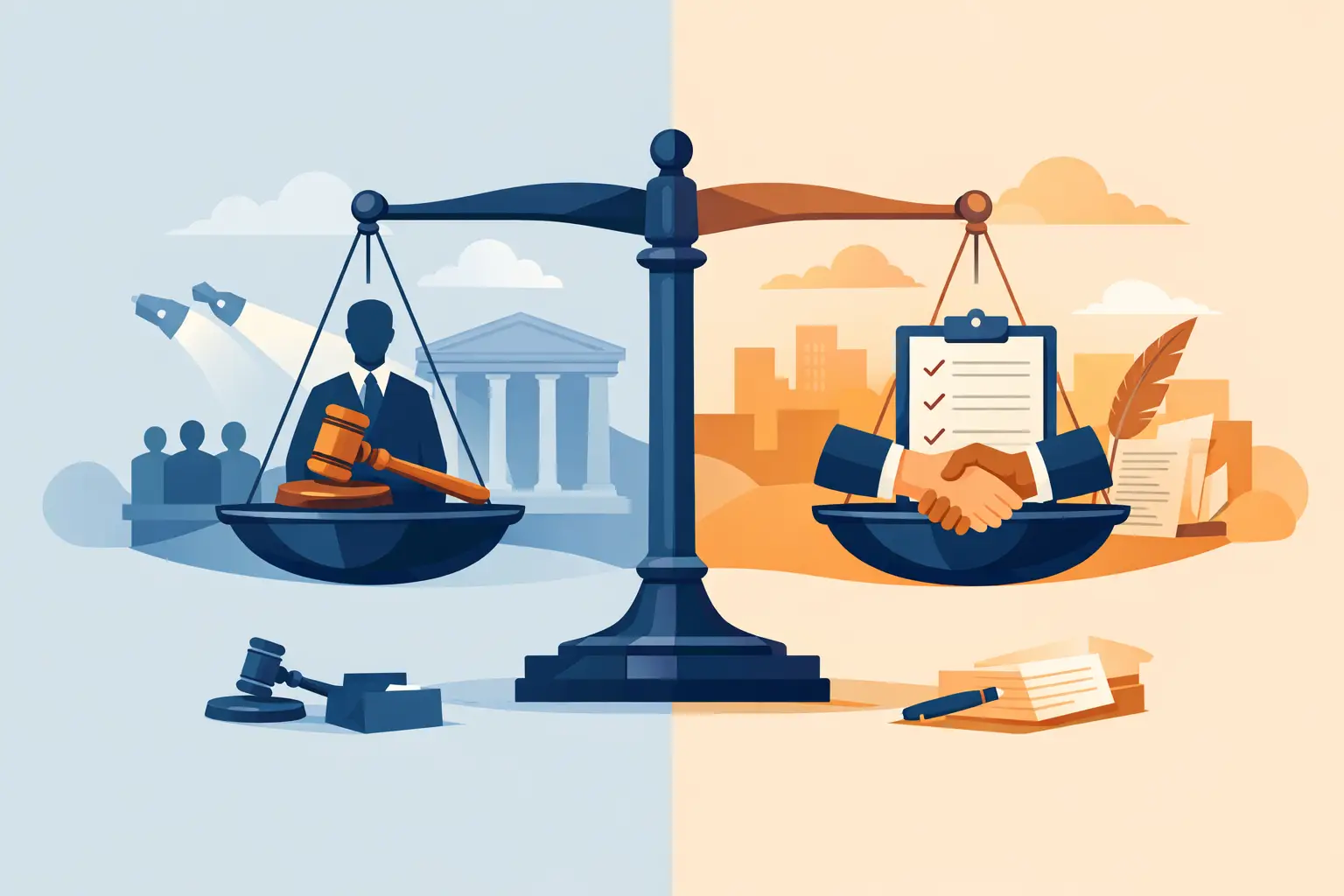
A plea agreement usually means the defendant agrees to plead guilty or no contest in exchange for something from the government. That might be reduced charges, fewer counts, a sentencing recommendation, an agreed sentence, or dismissal of other allegations. A trial means the prosecution has to prove the case beyond a reasonable doubt, and the defense has the opportunity to challenge the evidence in open court.
Neither path is automatic. A strong plea can be the right strategic move in one case. In another, accepting a plea too early can mean giving up defenses that could have changed everything.
What a plea agreement can offer
A plea agreement can create certainty in a process that often feels chaotic. If the evidence is strong and the sentencing exposure is severe, resolving the case through negotiation may reduce the damage. That can matter a great deal when someone is trying to protect employment, professional licensing, family obligations, or immigration concerns.
In some cases, a plea can cap risk. Instead of facing multiple counts and the possibility of a much harsher sentence after trial, a defendant may be able to resolve the matter on one count or with a more favorable sentencing structure. In state court, that can sometimes mean probation instead of jail. In federal court, it may mean a negotiated framework that reduces uncertainty, even if it does not eliminate punishment.
A plea can also shorten the timeline. Trials are expensive, demanding, and emotionally draining. Witnesses are interviewed, motions are litigated, personal history becomes part of the case strategy, and the stress can stretch on for months or longer. For some clients, a controlled resolution is worth serious consideration.
But certainty comes with a price. In most plea agreements, you are admitting guilt or accepting a conviction without forcing the government to prove its case at trial.
What a trial can protect
A trial preserves your right to challenge the government at every level. That includes whether the police lawfully stopped, searched, seized, or questioned you. It includes whether witnesses are credible, whether forensic evidence is reliable, whether the government can prove intent, and whether the story the prosecution is telling actually holds together.
This matters because criminal cases are not built on charges alone. They are built on proof. Sometimes that proof is far weaker than the arrest affidavit or indictment suggests. Witnesses change their accounts. Electronic evidence raises chain-of-custody problems. Search warrants are defective. Cooperating witnesses have motives to lie. Alleged financial patterns do not prove criminal intent. The government’s case may look stronger on paper than it does in court.
A trial can also create leverage before trial ever begins. Prosecutors negotiate differently when they know the defense is ready to file motions, challenge experts, cross-examine witnesses, and put the state or federal government to its burden. Trial readiness often improves plea negotiations, even if the case does not ultimately go to verdict.
The real factors that should drive the decision
Strength of the evidence
This is the starting point. Not just whether the government has evidence, but whether that evidence would likely hold up under scrutiny. A confession may be challengeable. A search may have violated the Fourth Amendment. A key witness may be vulnerable on cross-examination. Video may contradict the narrative in the police report.
If the case has serious proof problems, going to trial may be the only way to fully protect your position. If the evidence is overwhelming, the analysis changes.
Sentencing exposure
You need a clear view of the downside. That means understanding the maximum penalties, likely guideline issues in federal court, mandatory minimums, probation eligibility, collateral consequences, and what could happen if convicted after trial versus under a negotiated plea.
A plea that looks attractive on the surface may still carry consequences that are unacceptable. A trial that seems risky may make sense if the plea requires a felony conviction that would destroy a professional license or trigger removal proceedings.
Collateral consequences
For many people, the biggest damage is not limited to jail or prison. It is the impact on immigration status, security clearances, reputation, business interests, firearm rights, educational opportunities, and future employment. Those issues should not be treated as side notes.
A plea to the wrong offense can create consequences that outlast the sentence itself. That is why charge language, factual admissions, and sentencing terms matter.
The forum and the players
State court and federal court are different environments. So are different divisions, judges, and prosecutors. Some cases are heavily paper-driven. Others rise or fall on witness credibility. Some prosecutors negotiate early. Others only become realistic when they know the defense is ready for trial.
A decision this serious should be made with a defense lawyer who understands the courtroom where the case will be fought.
When a plea agreement may make strategic sense
A plea may be the better path when the evidence is strong, the sentencing exposure is substantial, and the negotiated outcome meaningfully reduces the risk. It may also make sense when a defendant has personal priorities that favor speed, privacy, or a more controlled result.
That does not mean pleading quickly. It means negotiating from an informed position. Early intervention can sometimes improve the terms, especially before the government locks into a theory of the case or adds additional charges. The key is not speed for its own sake. The key is timing backed by strategy.
When trial may be the right move
Trial may be the right move when the government cannot prove an essential element, when a constitutional issue could weaken or exclude key evidence, when the plea offer is worse than the actual trial risk, or when the long-term consequences of a conviction are too serious to accept without a fight.
This is especially true in cases where image and assumptions are doing too much work for the prosecution. White collar charges, conspiracy allegations, trafficking accusations, and high-visibility cases often come with a narrative that sounds powerful before it is tested. Trials force proof. That protection matters.
Why pressure is dangerous in trial versus plea agreement decisions
Many defendants feel pushed to decide before they fully understand the case. They are scared, exhausted, and trying to stop the disruption. Prosecutors may set deadlines. Family members may urge a quick resolution. The system itself can make trial sound like reckless gambling.
But pressure is not analysis. Before deciding on trial versus plea agreement, you need a grounded assessment of the discovery, the motions that can be filed, the witnesses, the likely sentencing range, and the real value of the offer on the table. You also need to know whether your lawyer is prepared to try the case if necessary. Negotiation has more force when the other side believes you will not fold.
At The Law Offices of Paul D. Petruzzi, P.A., that trial-ready approach is not a slogan. It is the framework serious criminal cases require.
What to do before you choose
Do not make this decision based on internet anecdotes or on the assumption that pleading guilty always leads to leniency. Ask for a direct assessment of the evidence, the likely trial issues, the sentencing exposure, and the collateral consequences. Ask what motions can be filed. Ask what weaknesses exist in the government’s case. Ask what happens if negotiations fail.
Most of all, make sure your decision is informed, not rushed. A plea should be accepted because it serves your interests after careful review. A trial should be chosen because the risks are justified by the defense, not because no one did the work to negotiate effectively.
When your freedom and future are on the line, the right choice is the one made from strength, preparation, and clear-eyed strategy.
Last updated: June 20, 2026
Important Disclaimer
This article is for general informational purposes and does not constitute legal advice. Reading this article does not create an attorney–client relationship. If you need legal assistance, please contact us for a Free Consultation.