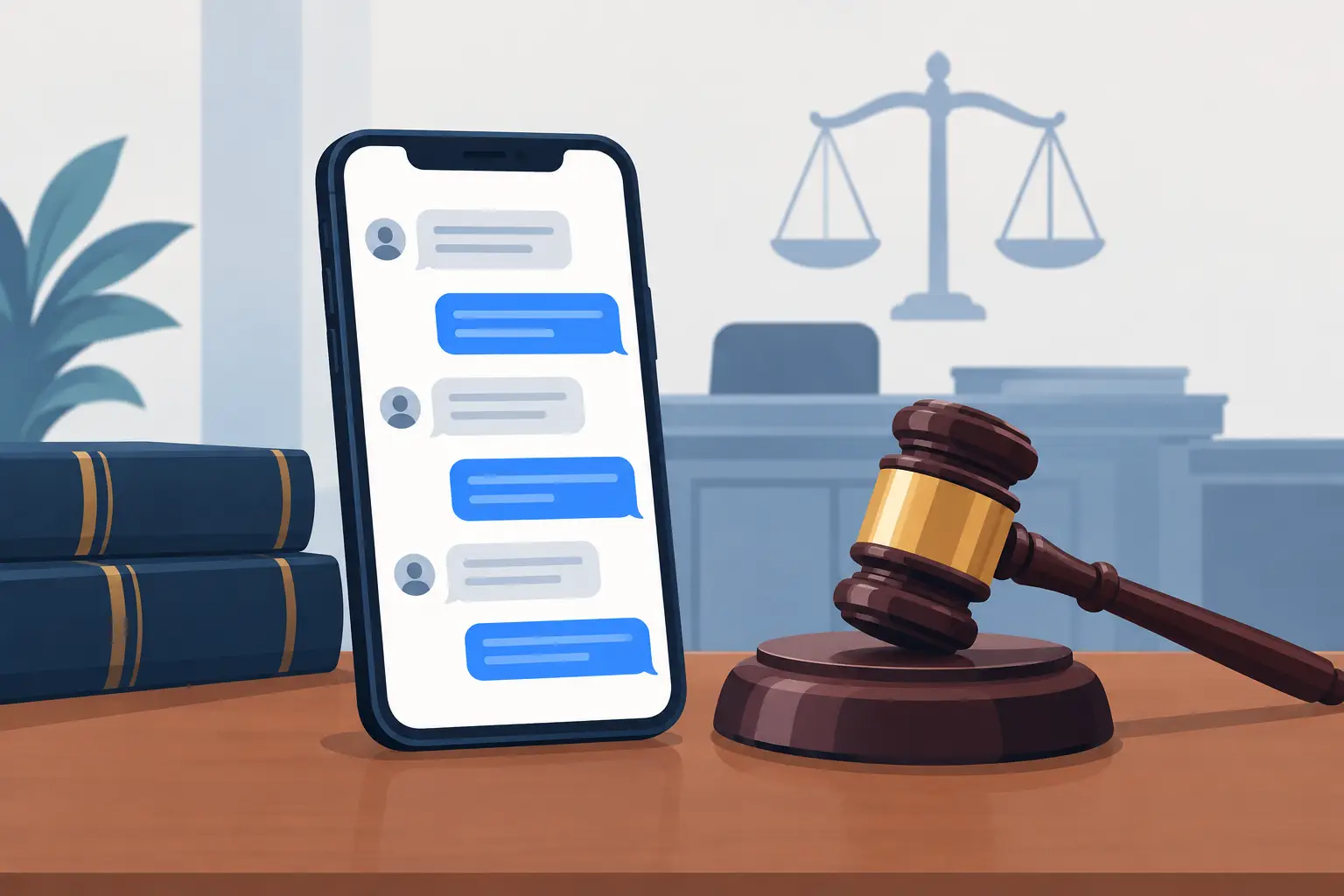
A single text can look devastating when it is read aloud in court: a short reply, a joke without context, a message sent while angry, or a screenshot with no surrounding conversation. But can prosecutors use text messages in a criminal case? Often, yes. That does not mean every text is lawfully obtained, accurately attributed, complete, or admissible at trial.
For anyone under investigation or facing charges in Miami-Dade, the danger is acting before understanding the stakes. Do not delete messages, alter a device, contact potential witnesses about what they wrote, or try to explain the conversation to law enforcement. Those decisions can create separate legal problems. Get counsel involved early, before a digital record becomes the prosecution's version of events.
Can Prosecutors Use Text Messages in Court?
Prosecutors may seek to use text messages to prove intent, knowledge, identity, an agreement between alleged co-conspirators, a threat, or a defendant's connection to an event. In federal investigations, texts often appear alongside call records, financial records, location data, social media evidence, and material recovered from seized devices.
A message, however, is not automatically evidence simply because it exists on a phone. The prosecution generally must clear several hurdles: it must have obtained the material legally, show that the message is genuine, establish who sent it, satisfy the rules against hearsay or identify a valid exception, and show that the message is relevant to an issue in the case.
Those are not technicalities. In a close case, they can determine whether a jury sees a damaging exchange at all, sees only a limited portion of it, or hears a defense explanation that changes its meaning.
How Prosecutors Obtain Text Messages
The source of the messages matters. It affects what legal process police needed and what challenges may be available to the defense.
A seized phone
Police may recover messages from a phone taken during an arrest, a search of a home, a vehicle stop, or another investigation. A lawful arrest does not give officers unlimited authority to search the contents of a smartphone. Phones hold an extraordinary amount of private information, and a warrant is commonly required to search their digital contents unless a recognized exception applies.
The warrant itself deserves close review. It should identify what investigators were authorized to search and seize. A broad search, an unsupported affidavit, an improper execution of the warrant, or a search outside the warrant's scope may support a motion to suppress.
A phone company or cloud provider
Investigators can also seek records from cellular carriers, messaging platforms, or cloud backups. The type of information available varies. A provider may have subscriber information, account data, limited message content, metadata, or records showing when communications occurred. Retention policies, encryption, and the particular service all matter.
Federal and Florida investigators may use subpoenas, court orders, warrants, consent, or other legal process depending on the information sought. Defense counsel should examine the process used rather than assume a provider's production was proper.
Another person's device or screenshots
Many cases turn on messages voluntarily supplied by a cooperating witness, an alleged victim, a former partner, or a business associate. Screenshots can be persuasive, but they can also be incomplete, edited, mislabeled, or detached from the conversation that gives them meaning.
A screenshot showing one hostile sentence may leave out the preceding threats, the follow-up clarification, the date, the contact information, or evidence that someone else had access to the account. The full thread, original device, backup records, and associated metadata can matter far more than an isolated image.
Authentication: Who Actually Sent the Message?
Before a text is admitted, the prosecution must offer enough evidence for a judge to find that it is what the prosecution claims it is. This is known as authentication. A contact name saved in a phone is not always enough to prove authorship.
The state or government may rely on testimony from the recipient, the phone number connected to a defendant, the content of the messages, distinctive language, references to facts only the sender would know, account records, device extraction data, or admissions made during an interview. In a conspiracy case, prosecutors may also try to use surrounding evidence to tie a person to a particular phone or account.
But phones are shared, borrowed, stolen, and accessed by family members, employees, roommates, and associates. Accounts can be compromised. Contact names can be changed. Messages can be forwarded or fabricated. A serious defense does not rely on a vague claim that "anyone could have sent it." It investigates access, timing, device ownership, account history, and the forensic record to identify concrete weaknesses in attribution.
Context Can Change the Case
Text evidence is particularly vulnerable to distortion because written words lack tone, facial expression, and the full conversation. Words such as "handle it," "take care of it," or "bring the package" can sound criminal when removed from the actual circumstances. They may refer to a legitimate business task, a family issue, sarcasm, or something entirely different.
Context is not merely a closing argument point. It can affect relevance, admissibility, and the jury's understanding of intent. The defense may need the entire thread, messages from the same period, related calls, business records, travel records, or witness testimony to explain what the parties meant.
There is also a trade-off. Seeking admission of additional messages may provide valuable context, but it can also open the door to other statements the prosecution wants the jury to see. The right approach depends on the facts, the charge, and the anticipated trial strategy.
Hearsay Rules Still Apply
A text message may be an out-of-court statement, but that does not end the analysis. A defendant's own statements are often offered against the defendant and may be admissible for that reason. Messages from other people require closer attention.
For example, an alleged co-conspirator's statement may be offered if the prosecution establishes the legal foundation that a conspiracy existed and that the statement was made during and in furtherance of it. A statement offered not for its truth, but to show its effect on the recipient or explain a later action, may be treated differently. The label the prosecutor gives the message is not controlling. The court must examine why it is being offered and whether the required foundation exists.
In high-stakes fraud, drug trafficking, RICO, and conspiracy prosecutions, this issue can be central. A prosecutor may attempt to turn another person's texts into evidence against multiple defendants. That effort should be tested carefully and early.
Constitutional Issues and Police Interviews
Text cases frequently raise Fourth Amendment questions about searches and seizures. They can also raise Fifth and Sixth Amendment issues when police question a suspect about a device, a passcode, or the meaning of messages.
Whether a person can be compelled to unlock a phone is a developing and fact-specific area of law. The answer can differ depending on whether investigators seek a passcode, a biometric unlock, or information they claim is already known. Do not try to negotiate that question on the spot. Ask for a lawyer and do not consent to a phone search without legal advice.
If officers already have your phone, preserve the facts. Write down when it was taken, who took it, whether you were shown a warrant, whether you gave consent, and what was said. Do not discuss the case by text, call, email, or social media with anyone except your attorney. Communications with friends, relatives, colleagues, and alleged co-defendants can become evidence.
What to Do When Text Messages Are Part of an Investigation
The first objective is to stop an avoidable mistake. Preserve your devices and records. Do not wipe a phone, reset an account, or delete cloud data. Destruction of evidence can expose a person to additional charges or damage credibility, even if the underlying messages would have helped the defense.
Next, obtain representation before responding to a subpoena, a request for an interview, a search request, or a demand to provide account access. A strategic review can identify whether investigators have a warrant, what records may exist, whether exculpatory context can be preserved, and whether early intervention is appropriate.
At the Law Offices of Paul D. Petruzzi, P.A., the focus is not on treating a text message as a foregone conclusion. It is on examining how it was obtained, whether it can be reliably attributed, what it actually means, and how it fits into the prosecution's larger theory.
When text messages become part of a criminal investigation, time matters. Protect the device, protect the full context, and protect your right to remain silent until experienced defense counsel can assess the evidence and take control of the next step.
Last updated: September 16, 2026
Important Disclaimer
This article is for general informational purposes and does not constitute legal advice. Reading this article does not create an attorney–client relationship. If you need legal assistance, please contact us for a Free Consultation.